
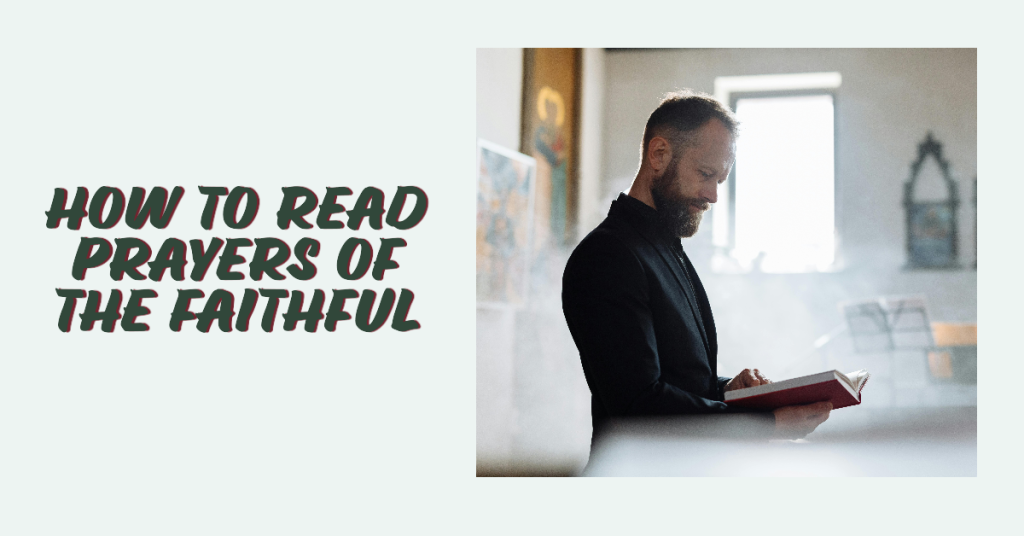

To read the Prayers of the Faithful at Mass, wait for the priest’s invitation, then announce each intention clearly from the ambo or another suitable place. Pause for the people’s response or silent prayer. The priest concludes the prayer. These petitions are also called the Universal Prayer or General Intercessions. If a deacon is assisting, he normally announces them; otherwise a cantor, reader, or another lay person may do so.
When should the reader go to the ambo?
The Universal Prayer closes the Liturgy of the Word. It follows the homily and the Creed when the Creed is prescribed. The priest invites the assembly to pray; then the person assigned to the intentions begins. After the priest’s concluding prayer, the Liturgy of the Eucharist begins. If the Creed is omitted at that Mass, do not wait for one. Follow the celebrant’s cue.
A practical way to proclaim each intention
- Prepare before Mass. Confirm the final text, the names that may be spoken, the assembly’s response, and whether a deacon will announce the intentions. Practice unfamiliar names and check the microphone.
- Wait for the priest’s introduction. Take your place where the parish directs. The priest begins and concludes the Universal Prayer; your assigned part is to announce the intentions.
- Read one intention at a time. Face the assembly, use a measured pace, and let each short petition end clearly. A brief pause gives the people room to pray and make the agreed response.
- Leave the response to the assembly. Do not hurry into the next petition or read over the people. After the last response, allow the priest to conclude.
For practice, an original sample intention is: “For teachers and students beginning a new school year, that they may learn with patience and serve one another with kindness, we pray.” Use the response chosen by your parish. This is a rehearsal example, not a prescribed liturgical text.
What should the intentions cover?
The General Instruction of the Roman Missal gives the usual pattern: the Church; public authorities and the world; people facing difficulty; and the local community. A wedding, funeral, or Confirmation may focus more closely on that celebration. Keep the petitions sober, concise, and expressive of the whole community’s prayer. The Instruction gives this pattern but does not set a universal number of intentions; coordinate the length with the celebrant and parish.
Common questions
Does the reader introduce and finish the prayer?
At Mass, the priest gives the brief introduction and concluding prayer. The deacon, or another assigned minister when appropriate, announces the intentions.
Must the people say “Lord, hear our prayer”?
The people may pray through a common spoken invocation after each intention or in silence. Use the response arranged for that Mass; do not assume one formula for every parish or celebration.
Official references
See the USCCB’s General Instruction, nos. 69–71 for purpose, subjects, roles, and the people’s response; and nos. 138–139, 177, and 197 for the sequence and who announces the intentions.